Organizer :
Department of Civil Engineering, UIU




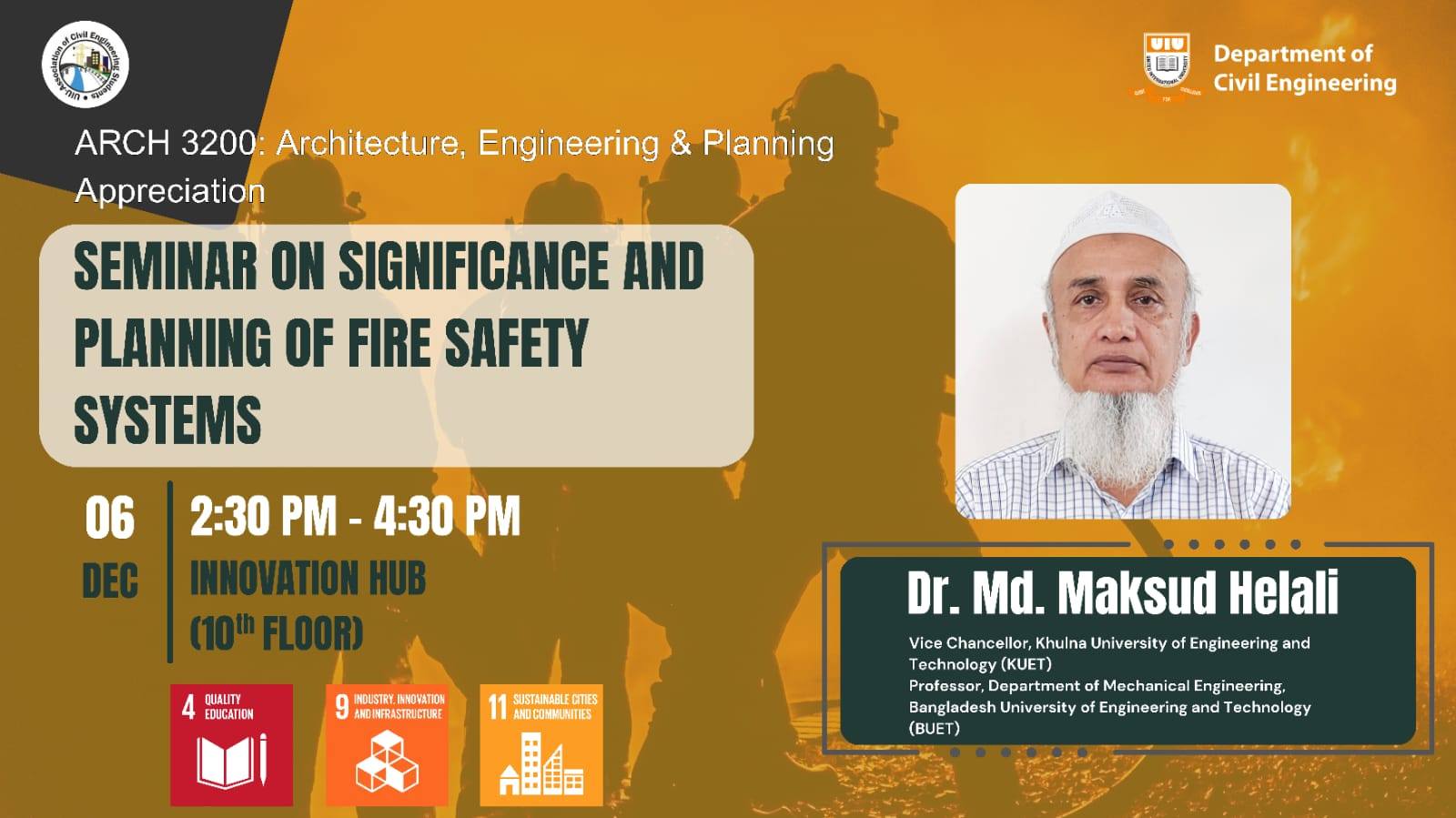
The Department of Civil Engineering, UIU, hosted an engaging seminar titled “Significance and Planning of Fire Safety Systems”, delivered by Dr. Md. Maksud Helali, Vice-Chancellor of Khulna University of Engineering & Technology (KUET) and former Professor, Department of Mechanical Engineering, BUET. Drawing on his long career as a researcher, teacher, and university leader, Dr. Helali offered a rare integrated perspective on building fire safety in the context of Bangladesh.
The lecture began with the fundamentals of fire science, fire triangle, ignition and pyrolysis, heat release, flashover, and the critical role of smoke, which accounts for the majority of fire-related fatalities. Using case studies of major incidents in Dhaka, including slum fires, high-rise fires, and mixed-use buildings, he illustrated how design flaws, improper vertical separation, unsafe glass façades, and unprotected stairs and lobbies can rapidly turn small incidents into disasters.
Dr. Helali then walked students through key provisions of BNBC 2020 (Part IV), RAJUK building regulations, and relevant international codes, focusing on occupancy classification, construction types, required fire ratings, and properly planned means of egress, such as corridors, fire stairs, horizontal exits, travel paths, and exit signage. He also discussed active fire protection systems such as hydrants, wet/dry risers, sprinklers, water-mist systems, fire pumps, and automatic detection and alarm systems (heat, smoke, and flame detectors), emphasizing design, reliability, and maintenance as non-negotiable responsibilities for professionals.
The session concluded with reflections on performance-based fire safety design and the ethical duty of future architects and engineers to integrate fire safety from the very first design sketch, not as an afterthought. Students left with a clearer understanding that safe buildings depend not only on technology and codes, but on informed, responsible design decisions at every stage of a project.